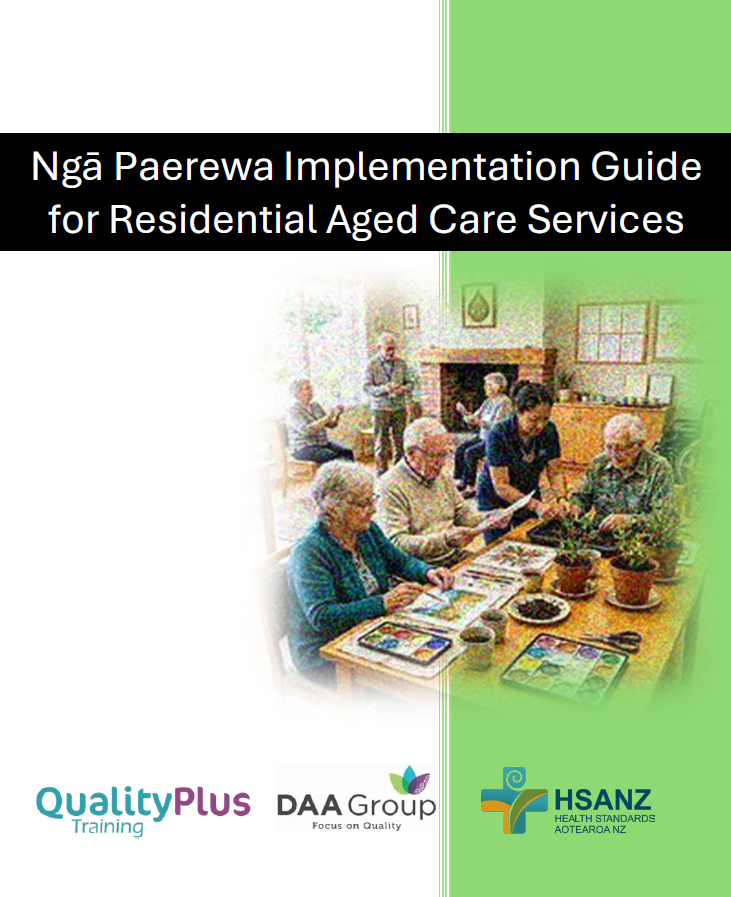
Ngā Paerewa Implementation Guide for Residential Aged Care Services 2026
NZ$25.00
We pride ourselves on our adaptability and commitment to excellence in every aspect of our service. Explore what we have to offer and how we can contribute to your success.
We offer a range of specialized services tailored to meet your individual needs. Our approach is focused on understanding and responding to what you require, providing effective and practical solutions. Below are examples of Standards we have project managed on behalf of project funders.
ASA Aeromedical Standard 2.0:2026.
This edition represents a comprehensive revision of the previous edition published in 2020, reflecting the significant regulatory, clinical, technological and operational developments that have shaped aeromedical practice across Australia and New Zealand over the intervening years.
The 2026 Standards respond to major drivers of change in both jurisdictions. These include the Australian CASA Parts 119, 121, 133, 135, 138 and 145 frameworks; implementation of the New Zealand Civil Aviation Act 2023 and Civil Aviation Rules Parts 99, 100, 119, 121, 125 and 135; contemporary Australian and New Zealand health quality frameworks; registration and regulation of health practitioners; advances in telemedicine and digital health; lessons from the COVID 19 pandemic; and the sector's commitment to workforce wellbeing, environmental sustainability and partnership with consumers and communities.
These Standards are designed to support aeromedical service providers in delivering safe, high‑quality, patient‑centred care. They establish minimum requirements while encouraging continuous improvement and innovation.

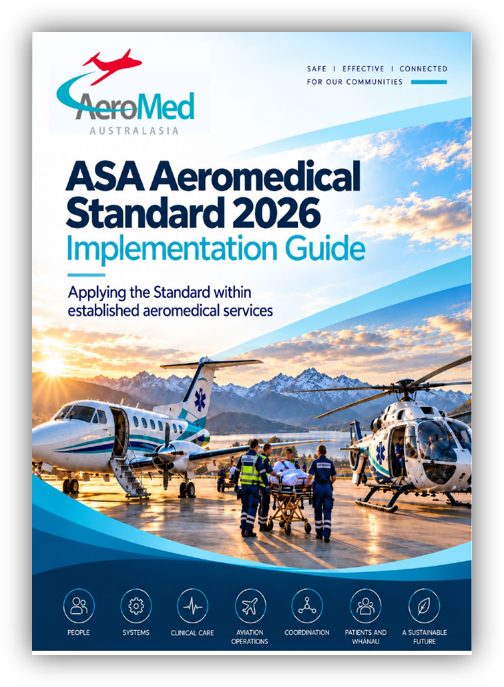
Implementation guide - Building on established excellence
Aeromedical providers in Australia and Aotearoa New Zealand have deep operational experience, mature clinical and aviation systems, and established regulatory, professional and independent assurance arrangements.
This guide recognises that capability. It is not a manual for constructing basic systems or a substitute for those already required by law, approval, professional practice or contract.
The voluntary ASA Aeromedical Standard 2026 offers a shared, patient-centred view across the whole aeromedical journey. Its distinctive value is often at the interfaces: where aviation, clinical care, coordination, specialist partners, patients and governing bodies depend on one another.
A sound, evidenced existing arrangement is an entirely satisfactory response to an ASA criterion. No additional process should be created simply to demonstrate that a process already exists.
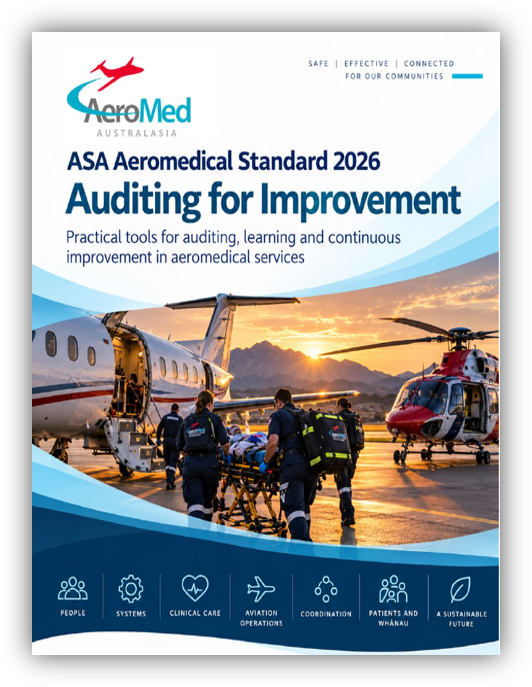
Auditing for Improvement
This guide explains how to undertake audits that generate learning and better care. It is deliberately not a second version of the ASA Standard, a prescriptive audit workbook or a criterion-by-criterion evidence list.
The ASA Standard defines the expected service outcomes and criteria; this guide describes an approach for understanding whether arrangements work across the complete patient journey.
A service may possess compliant policies, competent individuals, certified equipment and comprehensive reporting, yet still experience avoidable delays, difficult handovers, fragmented decisions or distress for patients and whānau.
System based auditing makes these interactions visible and then tests whether practical changes improve them.

New Zealand Aeromedical/Air SAR Standard
The goal of this Standard is to ensure the service provided by aeromedical services and air SAR services in New Zealand meet industry best practice, while remaining patient, or recipient, focus. The Standard promotes national consistency and risk management practices to ensure the safety of the crew and the patient remains paramount in all aspects of aeromedical and air rescue service provision.
The concept of predictive and pro-active safety and risk minimisation underpins the ongoing development of this document. Service providers wishing to provide these services must meet the standards contained within this document. This Standard has been developed, critiqued and peer-reviewed by the providers of aeromedical services and air rescue services [including clinical services].
Consultation and communication with key stakeholder organisations such as Health New Zealand | Te Whatu Ora, Accident Compensation Corporation (ACC), Aviation Industry Association (AIA), NZSAR Secretariate, National Air Desk, Civil Aviation Authority (CAA) and other organisations, including aeromedical providers and health sector experts has provided valued input to the Standard.
Introduction to UNHSEIP Service Standards
The programme has evolved significantly since its national rollout in 2010. Originally guided by the National Policy and Quality Standards (NPQS), the programme has now transitioned to these new Service Standards. This shift reflects a comprehensive review aimed at ensuring the standards are more whānau-centred, fit for purpose, and enable effective evaluation across the entire newborn hearing pathway.
The UNHSEIP Service Standards define nationally consistent requirements for safe, equitable, and culturally grounded delivery of universal newborn hearing screening and early intervention across Aotearoa New Zealand.
These standards should be interpreted in a manner consistent with Te Tiriti o Waitangi obligations, as well as people’s rights and service provider obligations under the Code of Health and Disability Services Consumers’ Rights and the Code of Expectations of Health Entities’ Engagement with Consumers and Whānau.
The standards sit alongside programme manuals, protocols, and monitoring frameworks, and should be read in conjunction with them. As the standards mature, associated documents will be aligned to ensure a coherent system for implementation and assurance.
These Service Standards provide the nationally consistent framework that underpins this work, setting clear expectations for quality, safety, and equity in service delivery. The standards guide services across every step of the journey: from early contact with whānau, to screening, diagnosis, intervention, and ongoing support. Importantly, they affirm that hearing loss should never define a child’s potential, and that timely, equitable access to interventions and supports, whether through audiology, speech and language services, and/or engagement with the Deaf community, can open pathways to thrive.

Better Care, Everyday - A Guide to Quality Improvement in Aotearoa New Zealand Health and Disability Services
This guide is a practical sector resource developed by Health Standards Aotearoa New Zealand for health and disability providers in Aotearoa New Zealand. It is designed for nurses, care managers, administrators, quality leads, service managers and frontline teams who want to strengthen everyday quality improvement practice.
The guide is not intended to provide service-specific consultancy advice or audit coaching. It supports general understanding of quality improvement, continuous learning, equity, Te Tiriti o Waitangi responsibilities, and practical improvement tools that can be used across small disability settings, community providers, residential services, private hospitals and larger provider groups.